
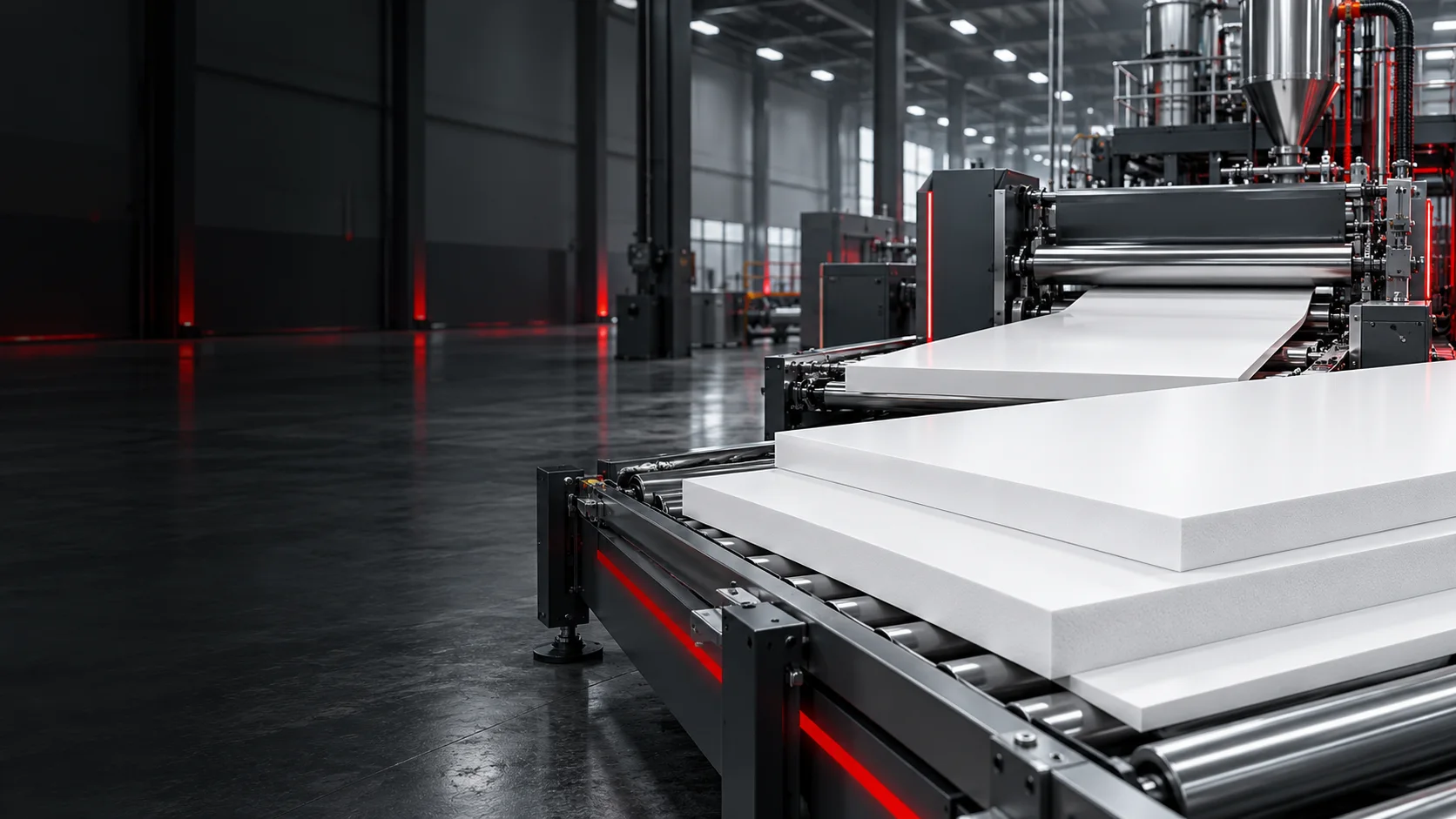
The three production types of PVC foam board compared: surface, rigidity, weight, printing and typical applications of free foam, celuka and CoEx sheets.
Not all PVC foam boards are made the same way. The production method determines the surface, rigidity and best application of the sheet.
Free foam PVC board
The melt foams freely after the die and is then calibrated. The result is a board with a uniform cell structure and a smooth, matte surface without a separate hard skin. Free foam boards are light, very easy to cut and excellent for printing, signage and displays.
Celuka PVC board
In the celuka process the outer layer is cooled immediately at the die while the inside continues to foam. This forms a hard, dense, glossy skin over a foamed core. Celuka boards are more rigid and scratch-resistant, hold screws better and are preferred for furniture, cabinets, construction and thicker sheets.
Co-extruded (CoEx) PVC board
Two or more extruders work together: a foamed core is combined with solid PVC skin layers in one process. CoEx boards combine a light core with a tough, high-quality surface. Toyopan’s UniFoam – CoEX is produced with this technology and is preferred in demanding uses such as ambulance interiors and medical cabinets.
Quick comparison
| Free foam | Celuka | CoEx | |
|---|---|---|---|
| Surface | Matte, smooth | Hard, glossy skin | Solid PVC skin |
| Rigidity | Good | High | High |
| Best for | Printing, signs, displays | Furniture, construction | Vehicles, demanding interiors |
Not sure which type you need? Contact our team.